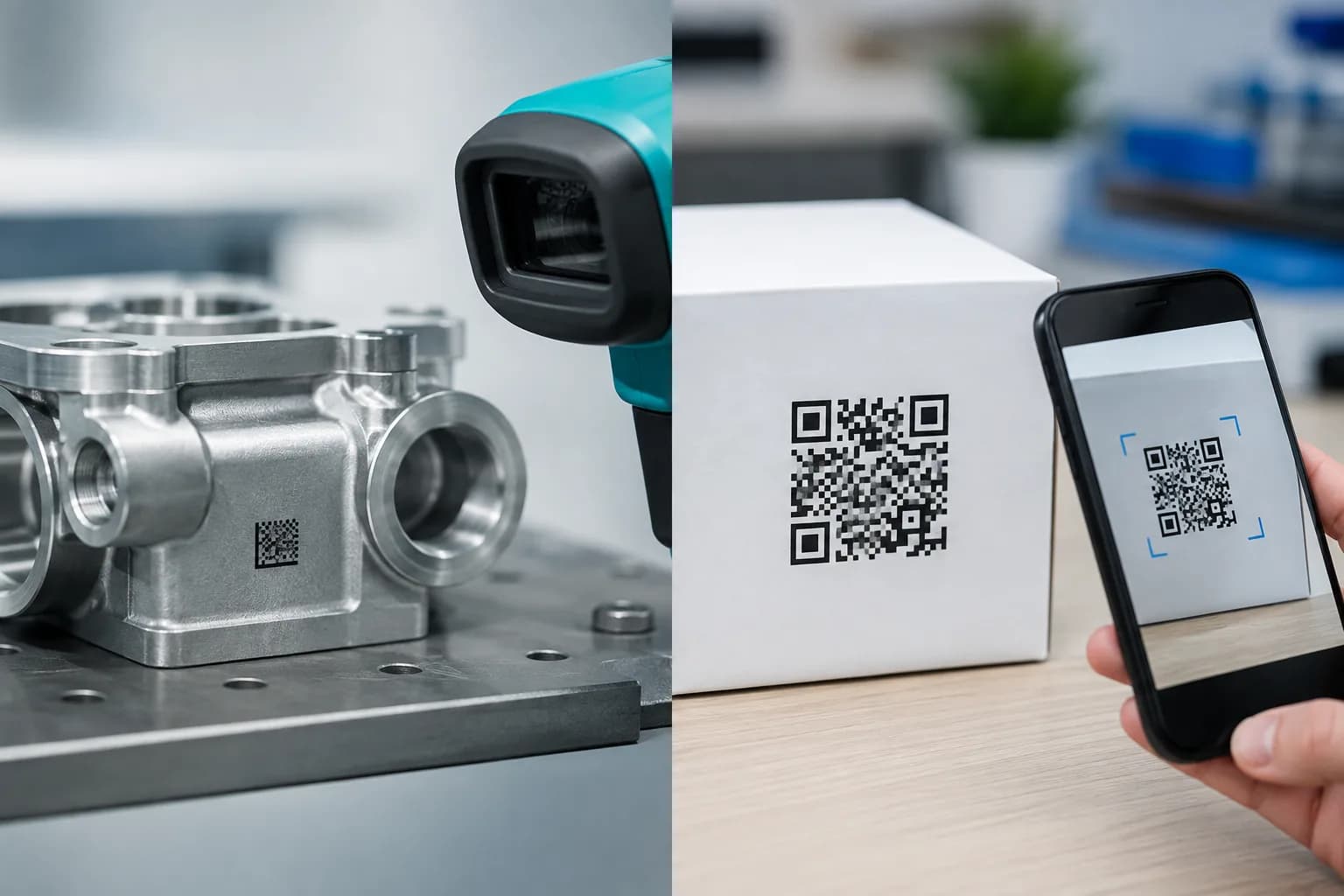
A Data Matrix vs QR Code comparison can look deceptively visual: both arrange light and dark cells in a compact two-dimensional symbol. Yet choosing by appearance is risky. A medical-device line, a laser-marked component, and a consumer package have different readers, standards, and consequences when a scan fails.
This Data Matrix vs QR Code guide compares the differences that matter in practice—finder patterns, capacity, size, mobile compatibility, direct part marking, GS1 syntax, and regulated use. If your project needs a customer-facing QR link rather than an industrial or regulated carrier, CraftMyQR can create customizable static and dynamic QR codes.
Data Matrix vs QR Code: The Short Answer
Choose Data Matrix when a standards-led industrial workflow needs a compact identifier, direct part marking, or GS1 DataMatrix—especially for healthcare product identification. Choose QR Code when ordinary people need to scan a URL with a phone camera or when a consumer-facing experience is central.
The key is not which symbol is “better.” It is which carrier the intended reader and receiving system are designed to process.
Both can be used in other contexts. Standards, scanner support, payload syntax, print method, and trading-partner requirements should make the final decision.
- Data Matrix: common in manufacturing, component marking, traceability, and GS1 healthcare applications.
- QR Code: common in mobile web access, campaigns, menus, instructions, payments, and consumer engagement.
How to Tell a Data Matrix From a QR Code
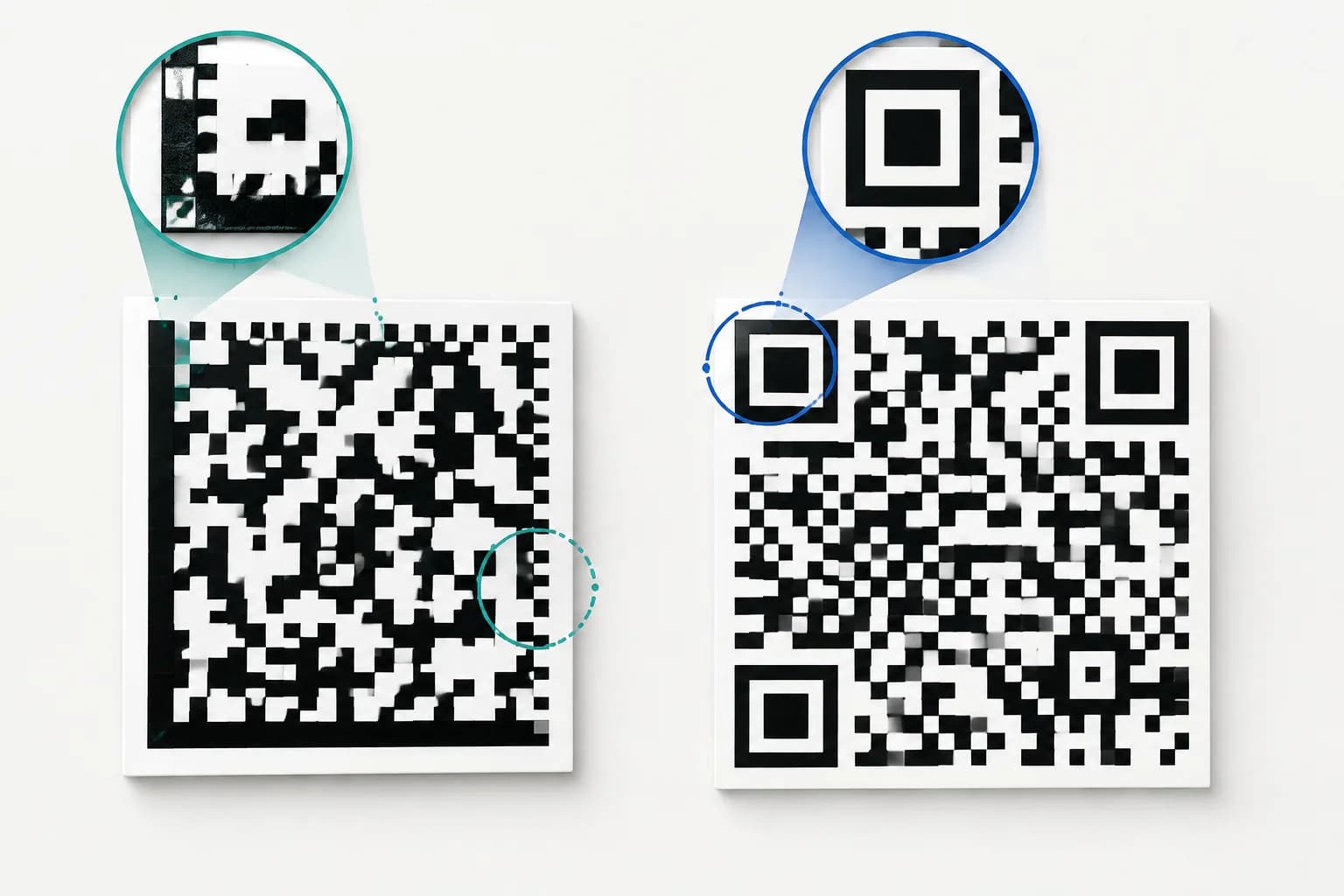
The finder pattern gives the quickest visual clue.
A Data Matrix symbol has a solid L-shaped border along two adjacent sides. The other two sides alternate light and dark cells. This “L” helps a reader locate and orient the data region. Larger symbols can contain multiple data regions separated by alignment structures.
A standard QR Code usually has three large square position-detection patterns in three corners. Smaller alignment patterns may appear inside larger versions, and a four-module clear margin surrounds the symbol in a compliant layout.
Color or rounded styling is not a reliable identifier. Look for the L-shaped Data Matrix finder border or the three prominent QR corner markers.
Data Matrix vs QR Code Comparison Table
The capacity values come from GS1’s 2D barcode overview. They describe maxima, not a recommended amount of data for every label. Error correction, character set, symbol dimensions, printer resolution, surface, reader optics, and required quiet zone all affect a real implementation.
- Symbol family: Data Matrix: 2D matrix barcode; QR Code: 2D matrix barcode
- Main visual marker: Data Matrix: Solid L-shaped border with alternating opposite edges; QR Code: Three large corner position patterns
- Common role: Data Matrix: Industrial traceability, compact labels, direct part marking, healthcare identification; QR Code: Smartphone links, consumer information, campaigns, payments, general data sharing
- GS1 capacity listed for common carrier: Data Matrix: Up to 3,116 numeric or 2,335 alphanumeric characters; QR Code: Up to 7,089 numeric or 4,296 alphanumeric characters
- Error correction: Data Matrix: ECC 200 uses Reed–Solomon correction; QR Code: Four selectable Reed–Solomon correction levels
- Shape options: Data Matrix: Square; rectangular forms also exist under applicable specifications; QR Code: Standard QR is square; related variants exist but are distinct formats
- Native phone-camera reach: Data Matrix: Inconsistent; often needs a compatible app; QR Code: Broad support for URL scanning in default phone cameras
- Industrial imaging readers: Data Matrix: Strong established use; QR Code: Supported where readers and software are configured for it
- GS1 healthcare product identification: Data Matrix: GS1 DataMatrix is the prescribed carrier; QR Code: GS1 says QR Code should not identify regulated healthcare products
- Consumer web experience: Data Matrix: Possible with the right syntax and reader, but less universally recognized; QR Code: Strong fit, especially with an HTTPS URL or GS1 Digital Link URI
What Is a Data Matrix Code?
Data Matrix is a two-dimensional barcode symbology that encodes data in a compact cell grid. Modern industrial implementations generally use Data Matrix ECC 200 with Reed–Solomon error correction. Manufacturers may print or permanently mark identifiers, batches, serials, or production data on electronics, instruments, and other assets.
Direct part marking
Direct part marking puts the symbol on the item rather than a removable label. Laser, dot-peen, or chemical methods must preserve cell geometry and usable contrast throughout the required life. Validate surface reflectance, curvature, lighting, optics, distance, and verification grade; one successful phone scan is not production proof.
Data Matrix is not always GS1 DataMatrix
Terminology matters. “Data Matrix” names the symbology. “GS1 DataMatrix” is a specific use of Data Matrix ECC 200 with GS1 rules, including the Function 1 Symbol Character and GS1 Application Identifier element-string syntax.
GS1 Application Identifiers label values such as GTIN, batch, expiration date, and serial number. A visually valid generic symbol is not automatically compliant. Follow the current GS1 DataMatrix guideline and sector rules.
What Is a QR Code?
QR Code is another two-dimensional matrix symbology, developed by DENSO WAVE for automotive production and now used in consumer, payment, ticketing, and industrial workflows. Its three large finder patterns support fast orientation. The standard has 40 versions and larger theoretical capacity than Data Matrix, but its consumer advantage is simpler: default phone cameras commonly open an encoded HTTPS URL.
Static and dynamic QR codes
A static QR code stores its final content directly. A dynamic QR code stores a managed redirect URL, allowing the owner to update the destination and record scan activity. This static-versus-dynamic distinction describes URL management; it is separate from the Data Matrix vs QR Code symbology choice.
CraftMyQR’s dynamic QR code tool supports editable URL destinations and scan-event reporting. It does not convert QR into Data Matrix or certify industrial symbols.
Capacity and Physical Size
QR Code has the larger published maximum capacity in GS1’s overview. That does not make it physically smaller for every payload or better for every tiny mark.
Data Matrix uses its area efficiently and is widely selected for compact industrial identification. QR Code devotes visible space to position and alignment structures that support camera orientation. Actual size depends on data, encoding mode, correction, version, and margin.
When space is tight, define the required data and syntax, select the permitted carrier, calculate cell size, match the print process, and validate with the production reader. Do not simply shrink an image until it fits; once cells fall below the printer-reader system’s capability, theoretical capacity becomes irrelevant.
Error Correction and Damage
Both formats use Reed–Solomon error correction but structure it differently. QR offers four selectable levels; DENSO WAVE lists approximate restoration from 7% to 30% of codewords. Data Matrix ECC 200 applies correction according to its symbol structure. Neither survives arbitrary damage, poor contrast, reflection, distortion, or undersized cells, so verify production samples under the relevant quality standard.
Scanner Compatibility: Who Will Read the Code?
This is often the deciding factor in a QR Code vs Data Matrix choice.
Consumer camera scanning
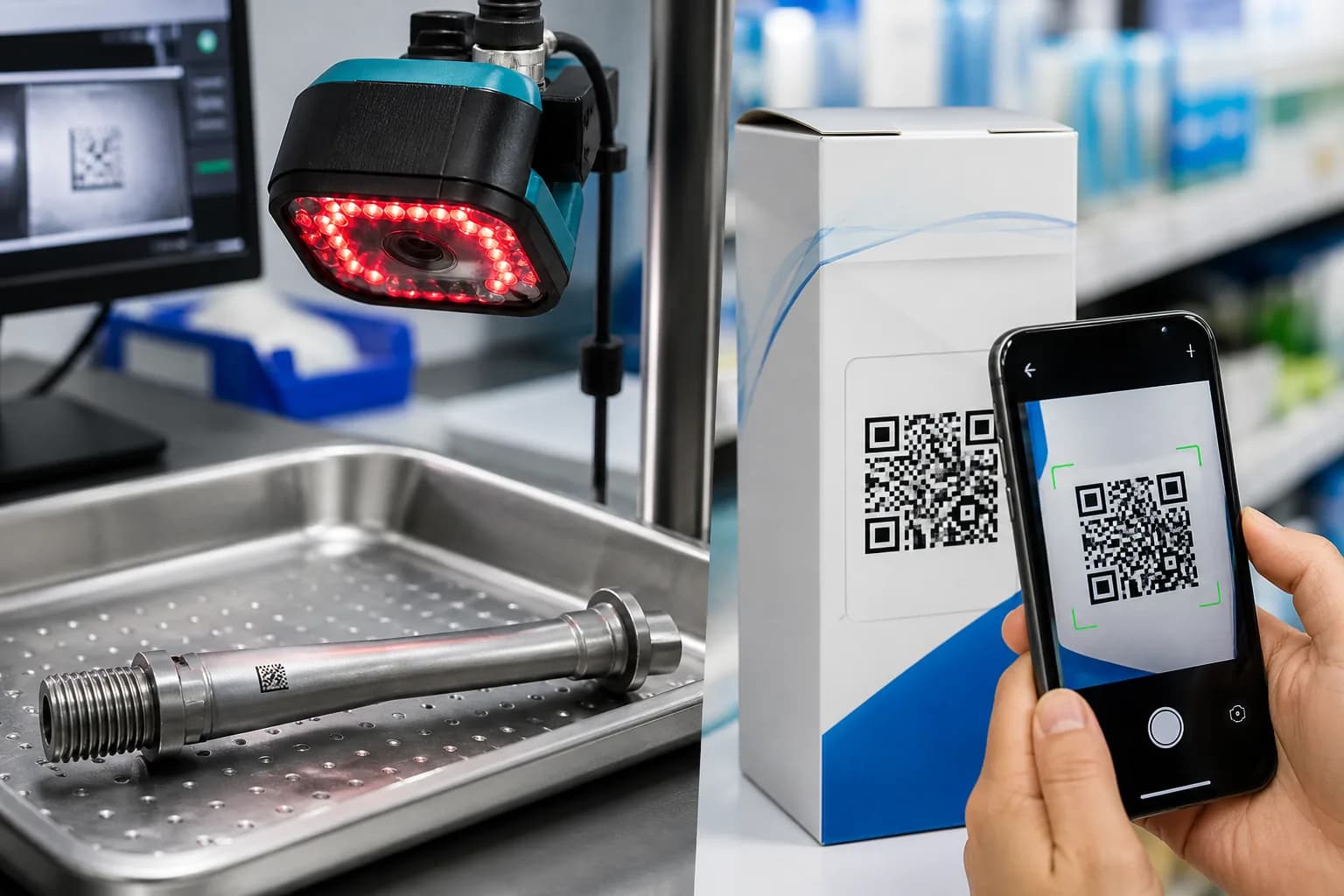
QR Code is the safer default for an open audience. GS1 says QR Code with GS1 Digital Link URI syntax is currently preferred for consumer engagement because default mobile camera applications can scan it and connect to a web resource.
Data Matrix support varies, and a specialized app may be required. Do not assume every customer’s default camera will offer the expected action. GS1 notes this difference in its comparison of 2D barcode options.
Industrial and clinical scanning
Data Matrix has a mature role with image readers configured for production, logistics, and healthcare. Test decoding and downstream processing: a device can recognize the pattern yet send a value that the business system does not parse correctly.
GS1 DataMatrix vs QR Code With GS1 Digital Link
The phrase “GS1 barcode” does not describe one symbol. Its standards approve several carriers and syntaxes for defined applications.
In common use, GS1 DataMatrix encodes an element string in which Application Identifiers define values such as GTIN, batch, expiration date, and serial number. QR Code with GS1 Digital Link uses a web-compatible URI that can connect identifiers and attributes to online resources. Data Matrix with GS1 Digital Link URI syntax is another approved retail option and is distinct from GS1 DataMatrix element-string encoding.
Do not treat these names as interchangeable or create one by typing parenthesized values into a generic tool.
Consult the current GS1 General Specifications, your local GS1 Member Organisation, and receiving partners before production.
Healthcare: Follow the Carrier Requirement
Healthcare is where a casual Data Matrix vs QR Code recommendation can become unsafe. GS1’s healthcare 2D barcode guidance states that GS1 DataMatrix is the data carrier for healthcare product identification and that QR Code should not be used for that identification role.
GS1 DataMatrix can carry product and production data used in traceability, recalls, inventory, and clinical workflows. Requirements vary by market and product. A separate QR may sometimes provide electronic information, but it must not replace the mandated identifier or create scan confusion.
CraftMyQR is not the appropriate tool for regulated healthcare identification. It is designed for general QR workflows, not GS1 DataMatrix issuance or validation.
Retail and the Transition to 2D Barcodes
Retail is adopting more capable 2D carriers, but the transition is not a universal instruction to remove every EAN/UPC barcode. Scanner hardware, point-of-sale software, data syntax, and trading partners must all be ready.
GS1’s retail implementation guideline describes QR Code with GS1 Digital Link, GS1 DataMatrix, and Data Matrix with GS1 Digital Link as options in defined retail profiles. During dual marking, a product may still carry a linear POS barcode alongside a 2D carrier.
For retail, confirm the accepted carrier, encode GTIN and attributes with the correct syntax, plan how scanners choose among symbols, and validate point-of-sale processing. Follow size, placement, quality, and human-readable-text rules. A generic marketing QR and a GS1-compliant retail QR are not automatically the same thing.
When to Choose Data Matrix
Data Matrix is usually the stronger candidate when:
Examples include medical-product identification, electronics, precision parts, laboratory samples, aerospace components, and manufacturing work-in-progress. The exact carrier still depends on sector guidance.
- A regulation or application standard specifies GS1 DataMatrix.
- The mark must fit a very small industrial surface.
- A controlled imaging scanner reads the symbol.
- Direct part marking is required.
- The payload is a compact product, lot, expiry, or serial structure.
- The workflow prioritizes traceability over public camera recognition.
When to Choose QR Code
QR Code is usually the stronger candidate when:
For example, a product can use an operational carrier for traceability and a QR link for setup instructions. Keep their purposes explicit and follow placement rules so neither users nor scanners select the wrong symbol.
When the use case is a standard web or contact QR, CraftMyQR supports URL, text, Wi-Fi, vCard, email, phone, SMS, and location-related workflows. It also offers PNG, SVG, and PDF output. Use its print guide to test QR artwork before production.
- Customers scan with ordinary phones.
- The code should open a webpage, menu, form, manual, or profile.
- A recognizable public call to action matters.
- The URL may need dynamic routing and scan reporting.
- The design will appear on marketing print, signs, cards, or consumer packaging.
A Practical Selection Checklist
Before approving either format, document these answers:
If any answer is unknown, pause production. A small test batch and a partner review cost less than relabeling finished goods.
- Who scans the symbol: a consumer, operator, clinician, retailer, or machine?
- Which devices, apps, and backend systems must process it?
- Does a regulator, customer, or GS1 application standard prescribe the carrier?
- What exact data and syntax must be encoded?
- How much physical area and quiet zone are available?
- Which printer or marking method will create the cells?
- What damage, chemicals, glare, curvature, or abrasion will the mark face?
- How will the production symbol be verified and audited?
- Does a URL destination need post-print editing or scan reporting?
Conclusion: Choose the Reader and Standard First
The Data Matrix vs QR Code decision becomes clearer when you begin with the reader and required standard. Data Matrix excels in compact, controlled, industrial and healthcare identification workflows. QR Code excels when a broad audience needs quick mobile access to digital content.
CraftMyQR is a reliable fit for that second category: it creates customizable QR codes and supports managed dynamic URLs when a destination may change. It does not claim to generate or certify GS1 DataMatrix. Use it for consumer and general QR experiences; use a standards-qualified system for regulated, retail, or industrial identifiers. The right code is the one the complete workflow—not merely one camera—can process correctly.
Explore the CraftMyQR QR code guides for related comparisons, safety checks, scanning advice, and print guidance.
Frequently Asked Questions
What is the main difference between Data Matrix and QR Code?
Data Matrix uses an L-shaped finder border and is common in compact industrial identification. QR Code uses three prominent corner markers and is widely recognized by phone cameras for web access. The required scanner, syntax, and application standard matter more than appearance alone.
Is Data Matrix smaller than a QR code?
Data Matrix can encode compact payloads efficiently and is widely used on very small parts. Actual size depends on the data, symbol format, cell or module size, correction overhead, margin, printer, and reader. Compare calculated, standards-compliant symbols rather than assuming one fixed ratio.
Can a smartphone scan a Data Matrix code?
Some apps and devices can, but native camera support is not as consistent as it is for QR URLs. If customers must scan the code without installing an app, test the exact target devices or choose QR Code for the consumer-facing web experience.
Which holds more data, Data Matrix or QR Code?
GS1 lists maxima of 3,116 numeric or 2,335 alphanumeric characters for GS1 DataMatrix and 7,089 numeric or 4,296 alphanumeric characters for QR Code. Practical payloads should stay much shorter because density affects print size and reliable reading.
Is Data Matrix the same as GS1 DataMatrix?
No. Data Matrix is the underlying symbology. GS1 DataMatrix is a specific standards-based implementation of Data Matrix ECC 200 using GS1 element-string rules and Application Identifiers. A generic Data Matrix generator does not automatically produce a compliant GS1 DataMatrix.
Should healthcare products use Data Matrix or QR Code?
GS1 specifies GS1 DataMatrix for healthcare product identification and says QR Code should not serve that role. Requirements vary by jurisdiction and product, so manufacturers should follow applicable regulations, issuing-agency guidance, and the current GS1 healthcare specifications before labeling.
Can Data Matrix and QR Code appear on the same package?
They can in some approved workflows when each has a distinct purpose, but multiple symbols may confuse people or scanning systems. Follow sector and trading-partner rules, preserve required margins, label the consumer action clearly, and test every scanner path before production.
Can CraftMyQR generate Data Matrix codes?
CraftMyQR focuses on QR codes, including static content and managed dynamic URL codes. It does not claim to issue or verify Data Matrix or GS1 DataMatrix symbols. Use it when QR Code fits the reader and workflow, not for regulated industrial identification.
Need to create a QR code now?
Create and preview your QR code with our free generator. For long-term materials like menus, packaging and posters, consider upgrading to dynamic QR codes.